Recently, the research team led by Professor Zhu Minsheng from the Medical School of Nanjing University has made a groundbreaking discovery in understanding the etiology of ulcerative colitis (UC), providing the first evidence that the disease is caused by infection with a novel subspecies of Aeromonas (Aeromonas sp. MTB).
Due to its previously unknown cause, UC has been difficult to cure, affecting over 5 million patients globally. The research team discovered that the disruption of the intestinal mucosal macrophage barrier occurs prior to damage of the intestinal epithelial barrier, representing the "initiating event" in the development of UC colitis. Preemptive depletion of colonic macrophages in animal models significantly increased susceptibility to colitis, resulting in symptoms resembling UC. The team isolated and identified aerolysin—a macrophage-hypersensitive toxin—from cultured fecal samples of UC patients. This toxin is produced by Aeromonas sp. MTB. Under pathological conditions (such as antibiotic abuse or exposure to intestinal damaging agents), MTB can achieve long-term colonization in the gut. Infection with MTB in both wild-type and immunodeficient mice induced human UC-like colitis by disrupting the macrophage barrier. Aerolysin was identified as the key virulence factor responsible for MTB-induced colitis, and a neutralizing antibody strategy targeting aerolysin significantly prevented and alleviated MTB-induced colitis. The team analyzed samples from UC patients across 10 provinces and cities in China. Among 79 UC patients, 72.15% tested positive for MTB in their fecal samples, compared to only 11.52% positivity in 430 healthy controls. Aerolysin protein was detected in 4 out of 10 intestinal tissue samples from UC patients, primarily co-localized with macrophages, while no aerolysin signal was found in 5 normal control samples. These epidemiological findings indicate a significant correlation between MTB infection and UC. Given the markedly higher distribution of aerolysin—the key virulence factor of MTB pathogenesis—in the feces and intestinal tissues of UC patients compared to controls, aerolysin may represent a novel future target for UC diagnosis and treatment. The researchers anticipate that therapeutic strategies such as neutralizing antibodies and bactericidal approaches (e.g., phage therapy) could become a new generation of highly effective treatments for UC.
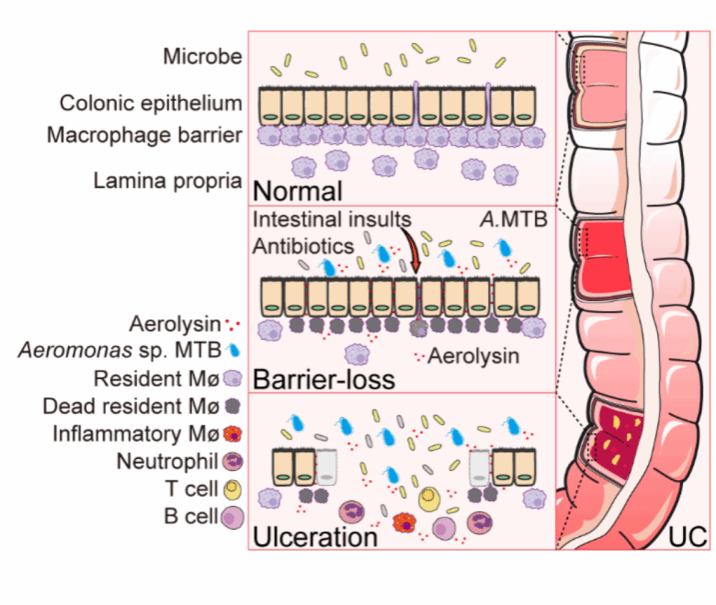
An Aeromonas variant, MTB, promotes susceptibility to ulcerative colitis (UC) by disrupting colonic macrophages.
The relevant research results were published on November 20, 2025, in the journal Science under the title " An Aeromonas variant that produces aerolysin promotes susceptibility to ulcerative colitis".
Source: https://doi.org/10.1126/science.adz4712